
Most workforce gaps don’t announce themselves. They start as a single open position, a spike in absenteeism, or a sudden departure that lands at the worst possible moment — mid-production run, heading into peak season, or the week a major order is due.
By the time it registers as urgent, the clock is already running.
For HR leaders and operations managers in manufacturing, warehousing, and logistics, this is a familiar pressure. A common response is to treat it as a staffing problem. Post the role. Call an agency. Ask a supervisor to cover. Get someone in the seat.
That instinct isn’t wrong. But it’s incomplete.
Because the real question isn’t just how you will fill the gap, it’s how you’ll keep operations moving while you do.
The Operational Stakes Are Higher Than They Look
An unfilled role on paper looks like a headcount issue. On the floor, it looks like something else entirely.
Shifts run short. Experienced workers absorb more than they should. Quality slips. Supervisors spend time managing the gap instead of managing the work. If the gap is large enough, or lasts long enough, you’re not just behind on output. The small gaps compound, and suddenly you’re creating conditions that put your team, your safety record, and your customer commitments at risk.
The cost is more than an empty seat. It’s everything that seat was holding up.
This is the distinction that matters most, and the one that often gets missed in the urgency of the moment: workforce gaps are operational continuity challenges, not just HR problems. How you respond — and how quickly — affects production, revenue, and the stability of your team.
Why Traditional Approaches Start to Strain Under Pressure
There’s no shortage of options for filling workforce gaps. The challenge is that most of them were designed for steady-state conditions, not for situations where time is short, volume is high, and the margin for error is narrow.
Leaning on your existing team is often the first move, and it makes sense when the gap is small and temporary. But overtime has a ceiling. Experienced workers can only absorb so much before fatigue becomes a risk of its own. Cross-training can help, but it often takes more time than delivery timelines allow.
Pulling back on production or service can be the right call in limited circumstances, including a slow period, a small shortfall, or a manageable window. But for most operations, scaling back means missed orders, frustrated customers, and a backlog that compounds the pressure you’re already under.
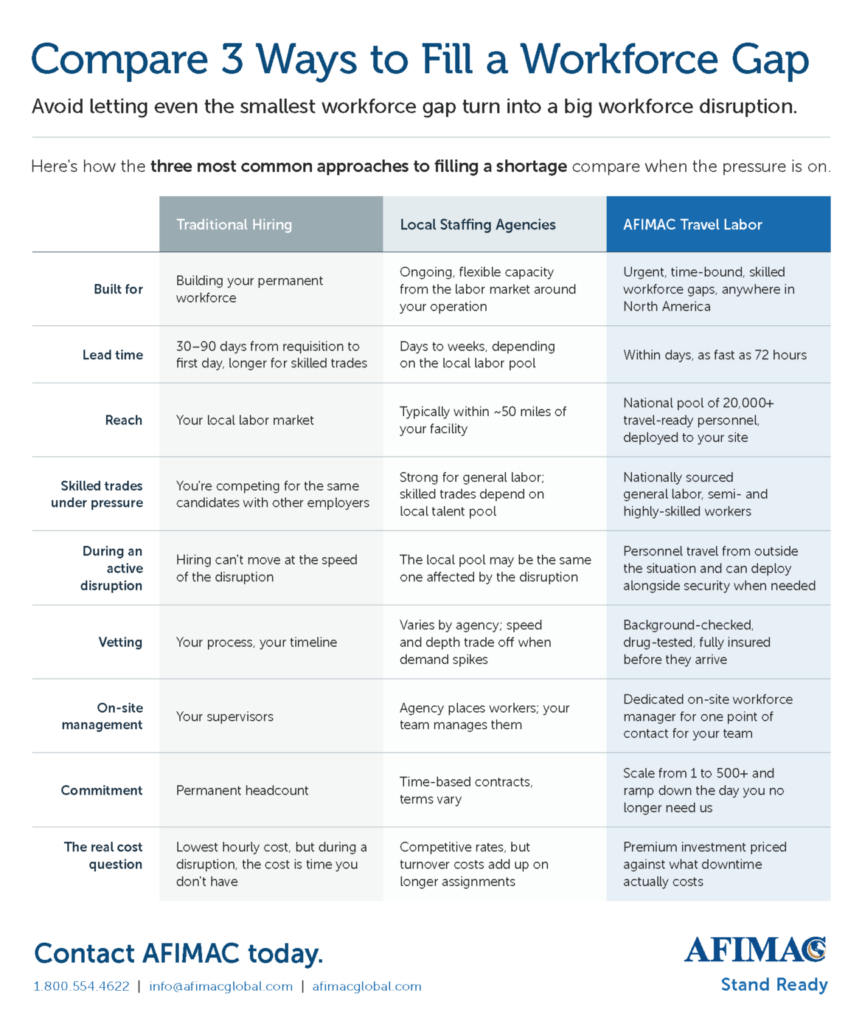
Hiring directly is the right long-term move and should always be part of your workforce strategy. Hiring directly, however, operates on its own timeline — national averages range from 26 to 44 days, depending on the role and industry. When operations are already strained, that window is rarely available.
Local staffing agencies serve an important function, particularly for steady, ongoing coverage. They know the local market, they can support temp-to-hire pipelines, and they’re a reasonable fit when the timeline is flexible and the need is manageable. Where they tend to strain is when the demand is sudden, the volume is high, or the required skills exceed what’s available in a defined geographic area. Geography is a fixed constraint, so when you need ten skilled workers by Monday, it becomes a hard ceiling.
None of these approaches is wrong. Each has a legitimate role in a workforce strategy. The gap shows up when the situation outpaces what the model was built to handle.
A Different Way to Frame the Question
Most conversations about workforce gaps start with cost. What’s the hourly rate? What’s the agency fee? What does it cost to fill this position?
Those are real questions. But they’re a misguided starting point.
The more useful question is: What does it cost if this role stays empty — or is filled poorly?
Downtime on a production line is measurable. Missed delivery milestones have consequences. Safety incidents carry costs that go well beyond workers’ compensation. And the organizational strain of running short-staffed — on your supervisors, your team, your culture — doesn’t show up in a spreadsheet, but it shows up in your business.
The conversation shifts when you move from hourly labor cost to total operational impact. It stops being about filling a seat and starts being about protecting what that seat was responsible for.
That’s the frame that tends to produce better decisions, not just faster ones.
What to Know Before You Need It
Workforce disruptions rarely happen on a convenient timeline. The leaders who navigate them most effectively have usually thought through their options before the pressure hits.
That doesn’t mean having a plan for every scenario. It means understanding the tradeoffs across the tools available to you. It means knowing what questions to ask. Not just about cost and availability, but about speed, scalability, on-site support, and what happens when things don’t go as planned.
Organizations that prepare in advance can respond quicker and are often better positioned to protect production, customer commitments, and operational stability when challenges arise.
The National Association of Manufacturers, in a 2024 study with Deloitte, reports that growth in the manufacturing industry is outpacing available labor.
It’s a significant gap they forecast will require 3.8 million additional workers by 2033. The silver lining is that the widening labor deficit can be attributed in part to a growing domestic manufacturing sector after decades of downsizing and offshoring. If that growth is to continue, however, manufacturers will need to address the labor shortage now and over the long term. More than that, though, manufacturers will need to rethink labor strategy to both source the needed people and skills and to maximize Return on Labor (ROL).