A skilled labor gap isn’t always a problem that can be worked through over a quarter. For many operations, the clock decides for you.
Food and beverage manufacturers are racing perishability, automotive suppliers run on just-in-time schedules, and logistics and distribution operations depend on throughput. In these environments, gaps in skilled labor don’t just reduce productivity. They convert directly into lost goods, missed orders, and revenue that doesn’t return.
That’s what makes today’s moment different. The labor gap itself isn’t new. The gap has been building for decades. What is new is that the time pressure on operations has caught up with it, and the slow-moving fixes the industry has leaned on aren’t built for the speed at which the costs now arrive.
A gap decades in the making
The shortage didn’t appear overnight. Over forty years, offshoring, automation, and consolidation steadily shrank demand for domestic manufacturing labor by nearly 40%. As jobs disappeared, so did the pipeline behind them: high schools, community colleges, and trade schools de-emphasized manufacturing skills, and a generation of would-be manufacturing workers was absorbed by the growing service sector.
Economic shocks accelerated the slide. The Great Recession erased 2.3 million manufacturing jobs and the pandemic took nearly 2 million more in 2020 alone. The decline hasn’t stopped since. The industry shed another 66,000 jobs in the 12 months ending April 2026.
Why the pressure is intensifying now
As employment declines, demand for skilled labor is set to grow, and that is creating a growing tension. Reshoring momentum, driven by supply chain vulnerabilities, geopolitical shifts, rising offshore costs, and federal and state incentives, has the industry forecasting a need for 3.8 million additional workers by 2033.
The available labor pool can’t simply be hired into the gap. As of April 2026, open manufacturing jobs and unemployed manufacturing workers were roughly equal in number, but workers aren’t interchangeable. Skillset, location, cost, and competition all stand between an open role and a viable hire, and the skills employers need are shifting toward technical and AI-adjacent roles faster than the workforce is retraining.
Meanwhile, critical labor situations, such as a sudden absenteeism spike, a major new order, an expansion on a deadline, keep happening at a small scale every day. For operations already running thin the smallest disruption can turn a chronic shortage into a significant loss.
The case for creative, concrete action
The labor gap has been decades in the making and a structural problem like this won’t be solved by posting more openings. Closing the gap demands a deliberately diverse strategy focused on: fast-track training and reskilling, reorganizing existing staff toward harder-to-fill roles, expanding geographic reach beyond local labor markets, tapping new talent pools, and building flexibility into how the work itself is structured. These are the steps that keep operational continuity at the center and mitigate risks that lead to larger disruptions.
Long term, the industry also has a perception problem to fix — 80% of Americans say the country would be better off with more manufacturing jobs, yet only 25% would take one themselves. The operations that weather this gap will be the ones that stop treating it as a hiring backlog and start treating it as the continuity risk it has become.
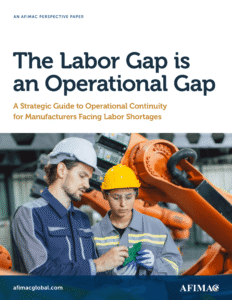
For a deeper look at the forces behind the gap and the strategies for closing it, read the full AFIMAC perspective paper, The Labor Gap is an Operational Gap.
The National Association of Manufacturers,
in a 2024 study with Deloitte, reports that
growth in the manufacturing industry is
outpacing available labor.
It’s a significant gap they forecast will require 3.8 million
additional workers by 2033. The silver lining is that the
widening labor deficit can be attributed in part to a
growing domestic manufacturing sector after decades
of downsizing and offshoring. If that growth is to
continue, however, manufacturers will need to address
the labor shortage now and over the long term. More
than that, though, manufacturers will need to rethink
labor strategy to both source the needed people and
skills and to maximize Return on Labor (ROL).