
It’s rarely just one open role. It’s the cluster of vacancies that arrive together — skills gaps compounding turnover, turnover compounding backlog — until the workforce shortage becomes an operational problem. Meanwhile, production is slipping, your team is covering the gap, and the pressure to fill positions is coming from every direction at once. If that scenario feels familiar, you already understand why more HR leaders are rethinking how they approach workforce planning.
The pressure HR leaders are already feeling
In this hiring environment, a better job posting or a faster interview process won’t fix what HR leaders are navigating now. From persistent skills gaps and high turn over rates to rapid technology adoption and policy shifts, workforce disruptions can happen fast and be hard to anticipate.
The result is that traditional hiring timelines and local talent pools are no longer reliable buffers against disruption. There is too much on the line while a seat sits empty.
Dynamic staffing is a model more HR leaders are putting into action — not because it’s a new idea, but because the conditions that make traditional hiring insufficient are no longer the exception. The approach isn’t a general-purpose fix, but in the right circumstances, it changes the equation entirely.
When traditional models hit a limit
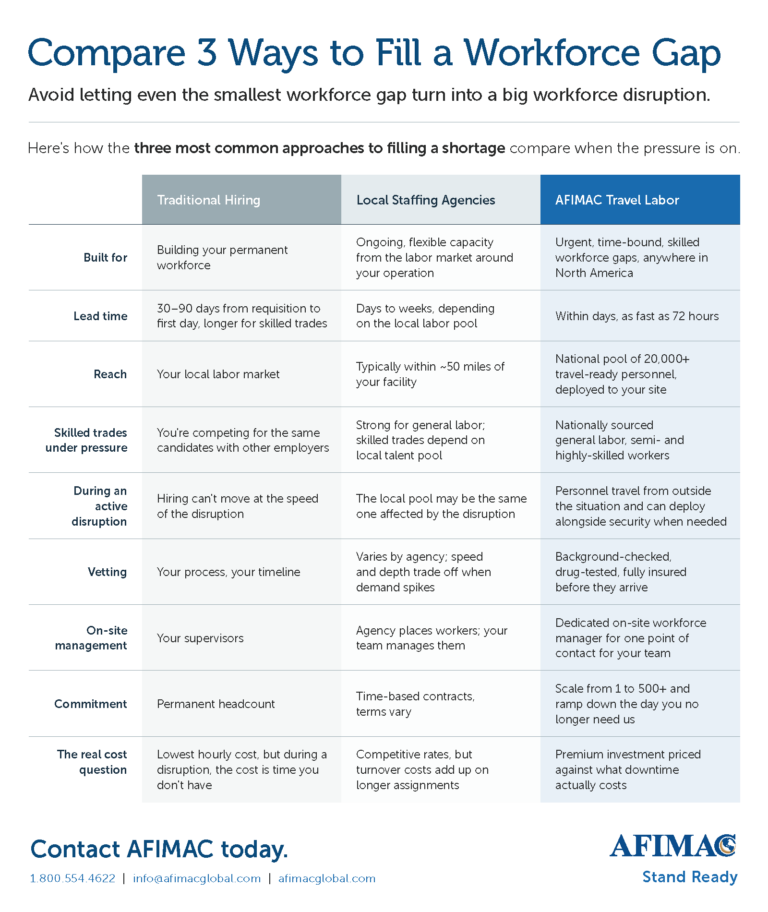
Traditional hiring and staffing models assume conditions that many employers no longer have: a local labor market with enough supply, a timeline that operations can absorb, and a hiring process with room to run. The current 63-day national average tells you how much runway those assumptions require.
A dynamic staffing model is not the right fit for everyone. But for those hiring in skills-scarce or geographically constrained markets, traditional processes create costly delays.
Likewise, permanent headcount was designed for stable conditions. It wasn’t built for seasonal surges, contract windows, or the kind of sudden disruptions — a backlog, a mass departure, a labor dispute — that can destabilize operations before a traditional search even gets started.
The real cost of waiting
Most organizations don’t start thinking about dynamic staffing until they’re already in a disruption. That’s the worst time to start. Options narrow when urgency spikes — and the cost of an unfilled role is almost always higher than it first appears.
It’s not just the wage. It’s the lost production output. The overtime burden on your existing team — the morale, the burnout, the safety risk that comes with running lean for too long. The customer commitments that slip. The management time absorbed by an extended search. By the time the pressure is visible, the cost is already compounding.
The conversation worth having now is not “what do we do when this happens?” — it’s “are we ready if it does?”
Why it’s worth considering before you need it
Implementing a new workforce model in the middle of a disruption adds friction at exactly the wrong moment. Evaluating your options before the pressure arrives gives you something more valuable: time to think clearly.
That means taking a real look at your business model — where the vulnerabilities are, what a staffing gap actually costs you, and what kind of partner relationship would give you meaningful coverage when conditions change. Organizations that have done this work ahead of time are consistently better positioned to respond when the moment comes.
The workforce pressures driving this conversation aren’t going away. The question is whether you’re building the capacity to respond to them now or scrambling to catch up later.
Interested in understanding whether a dynamic staffing model fits your organization? The right conversation starts with an honest look at where you’re most exposed, before you need to make a call in the middle of a disruption.